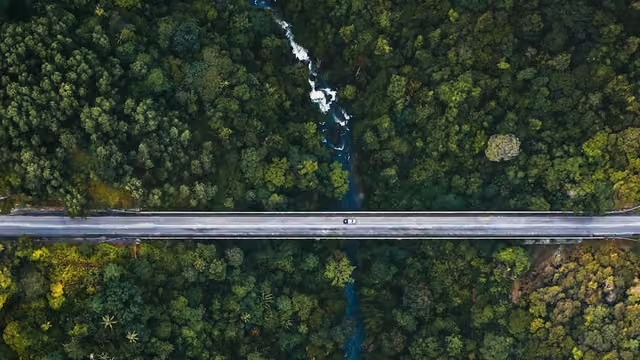
Plenty of people talk about an India-Thailand highway as if it is already a clean, driveable corridor. That is not the current reality. The project exists, big chunks are built, and the strategic idea behind it is serious. But the route still depends on Myanmar, and that is where the simple story falls apart.
If you only want the short answer, here it is: yes, the India-Thailand highway is still being developed. It is real, it runs through Myanmar, and it is not yet the smooth end-to-end road link people keep describing.
What the India-Thailand highway actually is
The proper name is the India-Myanmar-Thailand Trilateral Highway, often shortened to the IMT Highway. The core route is about 1,360 kilometres from Moreh in Manipur to Mae Sot in Tak province, crossing Myanmar through places such as Tamu, Kalewa, Yagyi, Monywa, Mandalay and Myawaddy.
The route was first proposed at a trilateral meeting in April 2002. Since then it has been sold as one of the key land links in India's Act East policy, and as a corridor that could eventually plug more directly into wider mainland Southeast Asian road networks.
| Segment | Status snapshot | Why it matters |
|---|---|---|
| Moreh / Tamu to Kalewa | Longstanding India-built access exists | Shows the corridor is not just a diplomatic idea. |
| Kalewa to Yagyi | Still the key bottleneck | This is the stretch that keeps the west Myanmar side from feeling finished. |
| Myawaddy to Mae Sot | Bridge and crossing infrastructure exist | The Thai end is real, but the border is still exposed to conflict and disruption. |
India-Thailand highway status in 2026
As of 7 July 2026, the best public status signal I found is still from 25 February 2025, when Hindustan Times reported remarks by Indian external affairs minister S. Jaishankar saying the roughly 1,400-km highway was nearly 70% complete. I did not find a later official completion notice or formal launch saying the full route has since opened end to end.
That matters because this project has spent years sitting in the awkward zone between "real enough to photograph" and "not reliable enough to treat as finished". If you are searching for India-Thailand highway status 2026, the honest answer is that it is still a partly built, partly constrained corridor.
What is already built
This is not a fantasy project. There are solid physical pieces on the ground, which is why the story keeps resurfacing.
- In August 2015, the Myawaddy-Thinggan Nyenaung-Kawkareik section in Myanmar was put into service, cutting travel time on that stretch from about three hours to 45 minutes.
- In December 2016, India said it had already completed the 130-km Moreh / Tamu to Kalewa stretch and was funding work on 69 bridges on the Tamu-Kyigone-Kalewa section plus the 120.74-km Kalewa-Yargi section.
- On 30 October 2019, the second Thailand-Myanmar Friendship Bridge at Mae Sot-Myawaddy officially opened to traffic.
That is why the corridor keeps sounding more complete than it is. There really is a road story here. It is just a road story with a stubborn missing middle.
The Myanmar problem is the whole story
If you want to understand why the India-Thailand highway is still not behaving like a normal overland route, start with Myanmar and stop there for a bit. Construction delays are one problem. Conflict is the bigger one.
In April 2024, fighting around Myawaddy, one of Myanmar's most important border gateways into Thailand, pushed about 1,300 people into Thailand and reached the area around the second Friendship Bridge. That is a useful reality check. You can have roads, bridges, border gates and trade ambitions, and still not have a corridor that behaves like a normal corridor.
The frontier has also been shaped by other pressures. In February 2025, Thailand cut power, internet and gas supplies to several Myanmar border areas as part of a crackdown on scam networks. That says a lot about the environment the Thai end of this route still sits beside. Border infrastructure does not only attract trade. It attracts every other frontier economy too.
Pros and cons of the India-Thailand highway
The upside
- More trade options: the route could give India, Myanmar and Thailand a stronger land corridor for freight, warehousing and cross-border logistics.
- More weight for Mae Sot: if the route stabilises, western Thailand becomes even more important as a gateway into Myanmar and further west.
- A better link for northeast India: Moreh and the wider northeast gain a more serious land connection to mainland Southeast Asia.
- Regional strategy: the corridor fits the wider logic of India-ASEAN connectivity and, eventually, links deeper into mainland Southeast Asia.
- Border-town upside: transport corridors usually create spillover demand for storage, trucking, services, hospitality and lighter industry.
The downside
- Myanmar is the choke point: the entire route still depends on a country in prolonged internal conflict.
- Crime and coercion around the border: scam compounds, trafficking routes and other grey-zone businesses complicate the Thai-Myanmar frontier.
- Paperwork can kill a corridor: customs, vehicle permissions, insurance and cross-border rules matter almost as much as pavement.
- Political overselling: big infrastructure projects are easy to announce and hard to finish. This one has already spent years in that gap.
- Uneven benefits: the first winners are usually large operators and gateway towns, not automatically the smaller communities people like to cite in speeches.
What this means for Thailand
For Thailand, the key node is Mae Sot. If the India-Myanmar-Thailand Trilateral Highway ever stabilises, Mae Sot becomes even more important as a west-facing trade gate. Trucks, warehousing, customs activity and regional logistics all lean harder into that border economy.
But Thailand also carries the spillover when the Myanmar side breaks down. Refugee flows, security alerts, border closures, checkpoint disruption and crime spill into the same space that trade planners are trying to sell as a corridor. Thailand gets the upside only if the Myanmar middle starts behaving like infrastructure instead of a permanent exception.
If you only want the shortest answer
Yes, the India-Thailand highway is still being developed. The project is real, the route runs through Myanmar, and as of 7 July 2026 it still does not look like a fully complete, seamless, ordinary road link from India into Thailand.
If you want another Thailand infrastructure story, read Phuket's Growth Is Moving North Into Phang Nga. If you want a separate Thailand rule change that actually affects move planning, read Thailand Cuts Visa-Free Stays From 60 Days to 30 Days.
Get the next one first
One useful email a week on building a life abroad. No spam.
- The Indian Express, 25 July 2015
- Business Standard on the Myawaddy-Kawkareik section, 31 August 2015
- Business Standard on the 130-km completed stretch and 69 bridges, 1 December 2016
- Greater Mekong Subregion Secretariat on the second Thailand-Myanmar Friendship Bridge
- AP on fighting near Myawaddy and the bridge area, 20 April 2024
- AP on Thailand cutting utilities to Myanmar border towns, 5 February 2025
- Hindustan Times on the project's 2025 status update