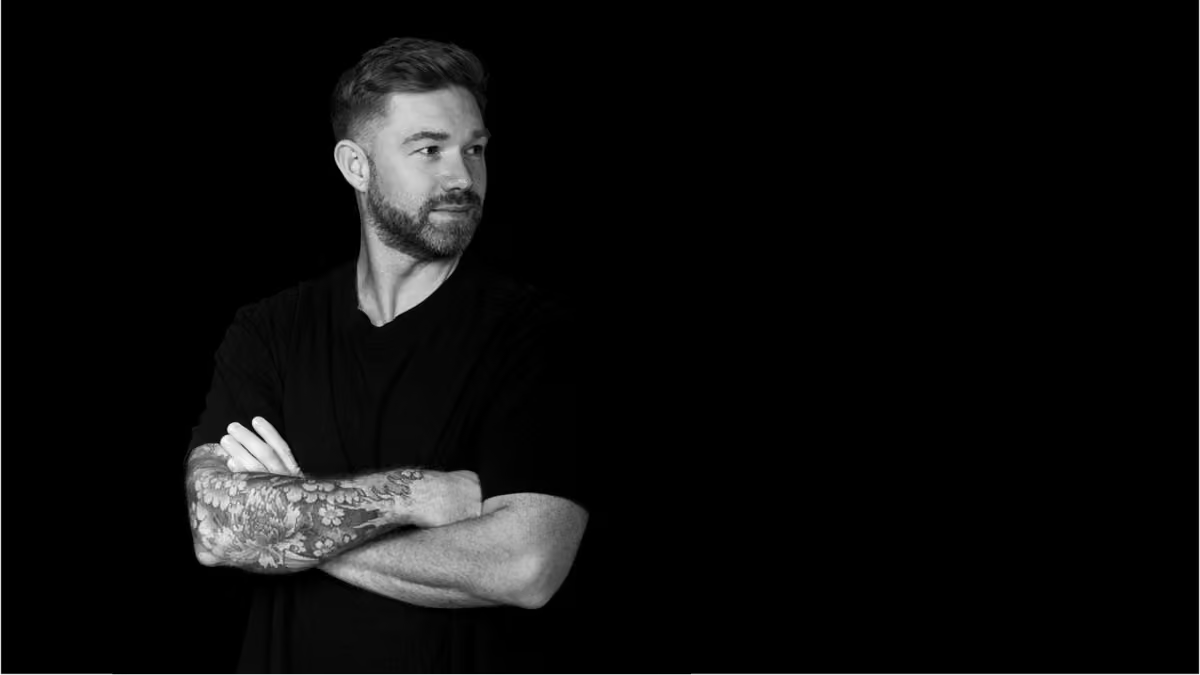
Julian Nevin has spent more than a decade with a one-way-ticket mentality: forty-four countries, a converted Mercedes campervan, a stint at a Bali dive school, and eventually a base in Phuket, a Thai wife, and a startup he now builds almost around the clock. He's the founder of SocialGryd, an app about helping people find their people, which he's currently building from a tiny box office with his ball python for company. We sat him down between work sessions.
Let's start at the beginning. What first brought you to Asia, and what made you stay?
I went backpacking in 2013 for a year, thirteen countries, and when I came back to the UK I didn't just have the travel blues, I knew the UK wasn't for me. Nothing against the people, or anything social or political. I was just addicted to it all: the food, the people, the culture, the lifestyle, and these incredibly beautiful places across Asia, which come with the added perk of being cheaper than home.
From 2019 I started seriously working out how to become a remote worker. I had a few goes at businesses to try and make the dream happen, and then lockdown hit. That's when I converted a long-wheelbase Mercedes Sprinter into a full motorhome: heating, hot water, shower, toilet, TV, wifi, you name it, all the gadgets. I sold that, and it put me in a position to finally move to Asia. I went to Bali first and worked at a scuba school for three months, diving almost every day, but I realised I needed money sooner rather than later. So I took an opportunity with a financial advisory firm over in Phuket, which was the place I'd been weighing up against Bali anyway. I landed, started making friends, met my now-wife Jenny, who's Thai, and everything kind of fell into place. I also do annual school photography at international schools, so I knew I had some financial security and a base in Asia, and honestly that was a huge part of being able to make the move.

Did Phuket feel like home straight away?
Not at all, and it took me a while. For over ten years I lived more of a travel life than a digital nomad one, always off to the Middle East, central and Southeast Asia, Europe for work, and in the gaps I was travelling anyway, mostly around Southeast Asia. So the idea of one place being home actually makes me a bit anxious, and there aren't many people who understand that feeling. But I knew I needed a base, somewhere I felt safe with a roof over my head.
After Phuket I trialled Koh Samui for six months, did more travelling, a couple of months in Bali, a couple in Singapore, back to the UK, then back to Phuket. That's when I finally realised why Phuket is the ideal place for me. I've always liked the idea of Bangkok, but that busy, corporate, nine-to-five-then-a-bar-then-shopping city life doesn't hit the spot. Phuket's got everything: the shopping centres, restaurants, quirky cafes, beaches, nearby islands, national parks, reservoirs, tropical jungle, an international airport, a Bangkok Hospital. Having all of that close by makes it, in my opinion, one of the best places to live in the world right now. But it honestly wasn't until I came back and found my people that I really knew Phuket was home. The biggest challenge was working out how to meet them. Where is everyone hiding? I couldn't be the only one in that situation.
And that's where SocialGryd comes in.
Exactly. The idea came straight out of what I just described. When I first got to Asia, the biggest challenge was connecting with like-minded people: finding community, working out who to trust, where the best places were. Eventually I met people who'd been in exactly the same position, and I realised this wasn't just an isolated thing. Travellers, expats, remote workers, digital nomads, we all feel that loneliness and isolation at some point. And it's not just us. People who never leave home feel it too. Friends change, people have kids, everyone changes as they get older, and it gets harder to find people who share your interests and hobbies.
Your tagline is "where your tribe shows up." What does tribe mean to you?
To me, a tribe is a group of people, or even just one or two individuals, who you can rely on and trust, open up to, share activities and experiences with. Almost like family. And that's the thing: when you move away from home and your family isn't here, you don't have family around you. So your friends and your connections become like family.
What's been the toughest part of building a life and a company out here?
The toughest part is the visas and the ever-changing laws here in Thailand, and the rest of Asia seems to be tightening up too. And income. Some people are okay because they're employed, but most people I know are freelance: traders, coaches, business owners, photographers, marketers. Hustlers, basically, building this life out here and making it happen.
What does a normal day look like?
It starts early. I wake up naturally around six, six-thirty, no matter how late I've stayed up or whether I've been on a night out, my body clock's like a Swiss clock. I've been intermittent fasting for a while, I like the 16:8, though I might not do it every day. I usually get straight to work and put in four or five hours, then fit my workout in after, or if I'm really in the zone I'll swap it to the afternoon. For training I just bought an adjustable kettlebell and use an AI workout planner to schedule my sessions, focusing on fitness and mobility more than strength and size, so I vary it day to day. I believe in listening to your body and your mind, but you've also got to push through the days you really don't feel it. Sometimes I'm so focused on building the company that training feels like a chore, even though I love it and feel great afterwards.
The rest of the day is more of the same: heads-down in my tiny box office with my ball python, Casper, who's all white and named after the ghost. It's also where I work out and get changed. I'm very much immersed in the startup lifestyle, and the irony isn't lost on me: SocialGryd is all about socialising and networking, but right now I'm glued to my computer being completely unsociable, just to get it to a point where I can take my foot off the pedal and actually start socialising again. By the evening I still don't really switch off. I try. I'll put a film or a series on with Jenny, but I've usually still got my laptop in front of me. Maybe the odd night out if there's something good on.
"I'm building a social network by being completely unsociable."
So why start Modern Expat Magazine?
As a professional photographer and videographer, I love documenting and telling stories, and I've got a real passion for personal branding and business development. What I'd love is to help individuals and brands build a presence. The magazine ties all of that together: it gives me a reason to get out, interview people and connect, and it doubles as a way to build and promote SocialGryd. There's a YouTube channel on the way too, interviewing people and showing more of the lifestyle out here, so if you're reading this it might already be live. It's all for exactly who the name suggests, modern expats: people working remotely, digital nomads, and anyone who's taken a job abroad.
One thing you wish someone had told you before you moved?
Explore all your options. One that doesn't get pushed enough is the education visa, it's probably one of the easiest ways to stay long-term. And try to meet and connect with people before you arrive, because if you move somewhere and don't end up making friends, you'll probably feel down, lonely, maybe even end up hating a place that actually has a brilliant underground scene, you just didn't know where to look. Which is, again, exactly why SocialGryd exists. Do your research.
Quickfire to finish.
Favourite beach? I don't get to the beach enough to really crown one, but I'll take the east side of Phuket over the busier west.
Go-to Thai dish? Jenny's pad kra pao. No contest.
Scooter or car? Scooter. But if you're here through the rainy season, get a car, no question.
Early bird or night owl? Early bird, whether I like it or not.
Most underrated thing about Phuket? Its reputation comes from one tiny area, Patong and Bangla Road. Head out towards Phang Nga Bay, the national parks, or the quiet east of the island where there's no tourism, and you'll see Phuket is an incredibly beautiful, peaceful island.
One word for life here? Conviction. Life isn't easy, and most people have dreams but feel pressure from friends, family and society to conform, a lifetime of conditioning about how you're supposed to live, not what you actually want from it. So here's how I see it: if people resent you for growing and becoming a better version of yourself, leave them behind. If they take it personally that you've gone quiet to focus on yourself, that's on them. And when friends or family try to tell you how to live, that isn't support. If you believe in yourself, that's the only conviction you need.
Fancy being featured?
We're always looking for interesting modern expats to interview, whatever your story. Tell us a bit about you and we'll be in touch. Someone will get back to you within five working days.