If you are flying out of Phuket, Bangkok, Chiang Mai or Samui in the coming weeks, a checked bag that sets off the X-ray can now be opened without you being there. That rule is not new: it took effect on 16 October 2026. What is new is a clarification issued by the Civil Aviation Authority of Thailand (CAAT) on Sunday 25 October, after several travellers posted about bags they believed had been searched.
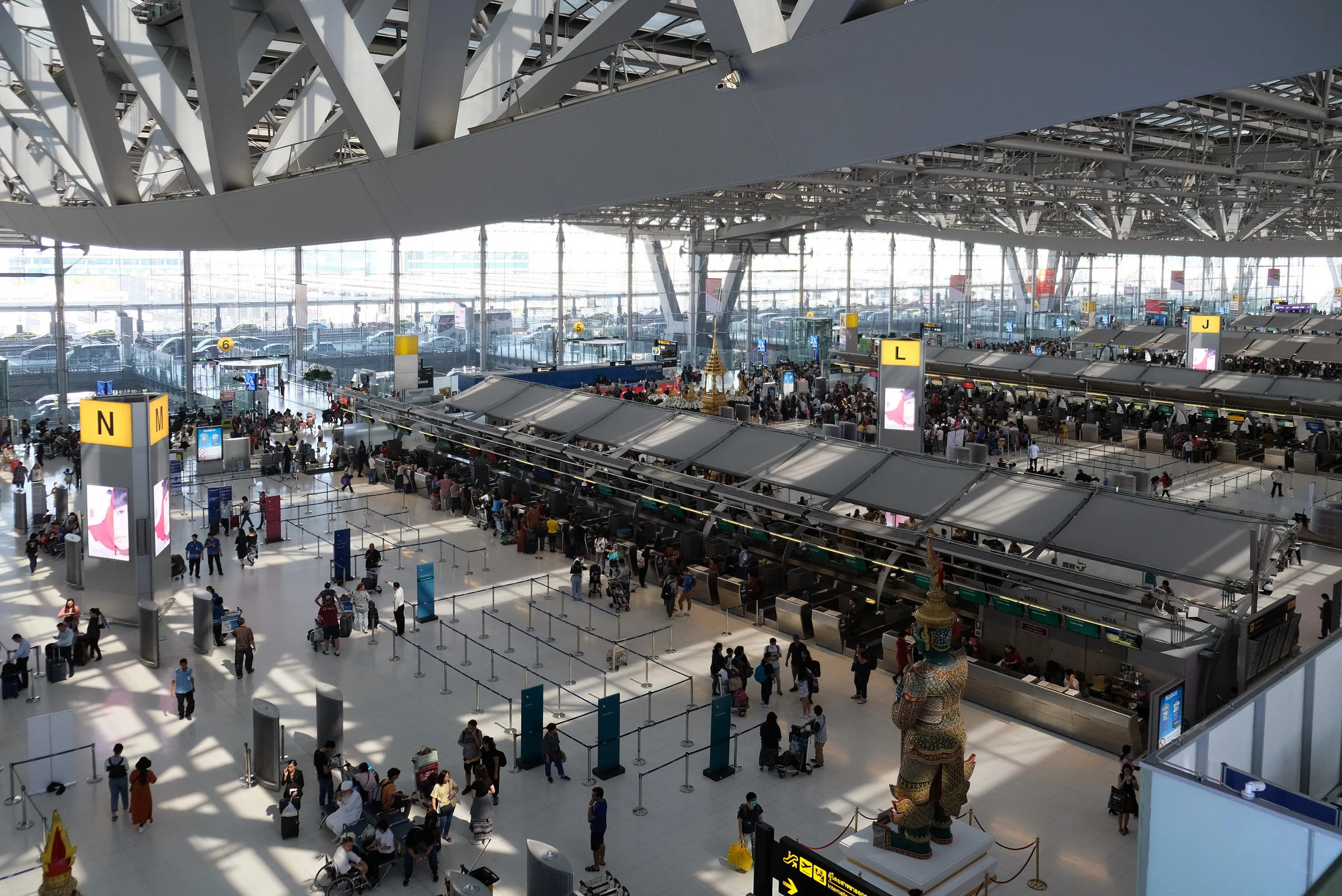
Illustrative image: the international check-in hall at Suvarnabhumi Airport, Bangkok (photographed January 2020). It does not show a baggage inspection. Photo: kallerna via Wikimedia Commons, CC BY-SA 4.0.
Here is what has been confirmed, and what it means for anyone travelling with checked luggage.
The rule in brief
CAAT's notification on the inspection of checked baggage carried on aircraft came into force on 16 October 2026, the government announced that day. Under it, authorised airport staff may open a checked bag without the passenger present, but only where X-ray screening raises a reasonable suspicion of a prohibited item or something that could affect flight safety.
CAAT says this is not a routine search of every bag. A flagged bag is taken to a designated area, the inspection is recorded on camera, and a Notice of Baggage Inspection is left inside so the owner knows it was opened. The government said on 16 October that the approach mirrors aviation security practice in countries including Singapore, Japan and South Korea.
What changed on 25 October
In its update (CAAT News 33/2569), the regulator said the first ten days had gone smoothly overall. It also answered three questions travellers had been asking.
**Domestic flights are included.** The rule applies to both domestic and international flights departing from Thai airports. That matters for residents who regularly fly between Phuket, Bangkok and the islands.
**Inbound flights are not.** Bags on flights arriving in Thailand are screened under the rules of the airport where the journey began, so Thailand's measure does not apply to them.
**Power banks are the main trigger.** The items most often found were power banks and other battery-powered electronic devices, which CAAT notes can short-circuit and catch fire in the hold.
The four cases CAAT looked into
CAAT said it checked four cases that had circulated on social media:
Two involved international flights leaving Thailand. Airport CCTV showed the bags had not been opened by screening staff under the new rule.
One involved a flight arriving from abroad, so the screening fell under the origin airport's rules.
One, on a domestic flight, was a genuine inspection under the new rule. Staff had found a battery-powered electrical device. Because the bag had no TSA-approved lock, they cut the zip to open it and left an inspection notice inside.
CAAT added that a bag opened outside the set procedure, outside the designated area or by someone not authorised does not count as an inspection under this measure. Checked luggage remains the airline's responsibility for the whole journey, so if a bag arrives damaged or something is missing, the first call is to the airline.
What to do before your next flight
Based on CAAT's and the government's own guidance:
1. **Keep power banks out of checked bags.** Carry them in the cabin, and check your airline's rules for other battery-powered devices.
2. **Use a TSA-approved lock** if you lock your case, so staff can open it without breaking it.
3. **Photograph the contents** before you close the bag, and the outside of the bag at check-in.
4. **Keep valuables, important documents and fragile items** in your hand luggage.
5. **Look for the notice.** If your bag has been opened, there should be a Notice of Baggage Inspection inside. If there is not, or something is wrong, report it to your airline.
Why it matters
High season is starting, and many residents will be flying domestically, heading home for the holidays or hosting visitors. The rule itself has been in place since 16 October; the useful news is that it now clearly covers domestic routes, and the most common trigger is something most of us pack without thinking. Moving the power bank into your carry-on is the simplest way to avoid a cut zip.
*Sources: Civil Aviation Authority of Thailand, CAAT News 33/2569 (25 October 2026); Government Public Relations Department (16 October 2026); Royal Thai Government, thaigov.go.th (16 October 2026); Bangkok Post (25 October 2026).*