Filling up in Thailand got cheaper on Wednesday 28 October 2026, but only for two grades. The Cabinet approved a three-month cut in the excise tax on E20 gasohol, a petrol blend containing 20 percent ethanol, and B20, a diesel blend containing 20 percent biodiesel. From midnight, PTT Station and Bangchak priced both fuels at 33.50 baht a litre in Bangkok.
The measure runs from 28 October 2026 to 27 January 2027. Every other grade, including gasohol 91 and 95 and regular diesel, stays at its previous price.
What the Cabinet changed
According to the Excise Department's statement, published by the Royal Thai Government on 27 October, the tax on B20 falls from 5.953 baht to 0.431 baht a litre and the tax on E20 falls from 6.000 baht to 0.358 baht a litre. That is a cut of roughly 5.5 baht a litre on B20 and 5.6 baht on E20. The department said the carbon element of the tax, set at 200 baht per tonne of carbon dioxide equivalent, stays in place; only the remaining excise portion was removed.
The government gave three reasons: to ease living costs, to lower costs for transport and business, and to support Thai farmers whose palm oil, sugar cane and cassava go into biofuels. Prime Minister Anutin Charnvirakul told reporters at Government House, as reported by The Nation, that the cut applies only to E20 and B20, not to all fuel, and that the government will review it after the first three months before deciding whether to extend or adjust it.
Why the pump price fell by less than the tax
Drivers will notice the price drop is smaller than the tax cut. The Excise Department said the Oil Fuel Fund, the state fund that subsidises pump prices, is carrying a heavy burden and that the tax cut is partly meant to share that load. Thai PBS reported that the Oil Fuel Fund's committee reduced its subsidy on both fuels on the same day, so part of the tax saving goes to the fund rather than to the forecourt.
The result, according to The Nation's report of the retailers' price lists, is that B20 fell by 3.69 baht to 33.50 baht a litre and E20 fell by 2.19 baht to 33.50 baht. Gasohol 95 remains at 42.04 baht, gasohol 91 at 41.67 baht and regular diesel at 43.54 baht. Those Bangkok prices exclude local maintenance tax.
What it means if you drive in Thailand
For the next three months, E20 is about 8.50 baht a litre cheaper than gasohol 95, and B20 is about 10 baht a litre cheaper than regular diesel, based on the Bangkok prices above. On a 40-litre tank that is a saving of more than 300 baht against 95.
The saving only helps if your vehicle is built for the fuel. Not every car, pickup or motorbike is approved for E20 or B20, so check the owner's manual, the label inside the fuel flap or the dealer before you switch. Hire cars and rented scooters are worth checking with the rental company first.
In Phuket, the price board on the website of the Phuket Provincial Energy Office, part of the Ministry of Energy, listed E20 and B20 at 33.50 baht a litre at PTT and Bangchak on 28 October. The page does not say whether those are local or Bangkok reference prices, and prices outside Bangkok can differ slightly, so check the pump.
The cut is temporary. Unless the government extends it, the lower excise rates end on 27 January 2027, and pump prices can still move before then if the Oil Fuel Fund changes its subsidies or world oil prices shift.
Sources: Excise Department statement published by the Royal Thai Government (27 October 2026); Phuket Provincial Energy Office, Ministry of Energy, retail price board (28 October 2026); The Nation (27 and 28 October 2026); Thai PBS (27 October 2026).
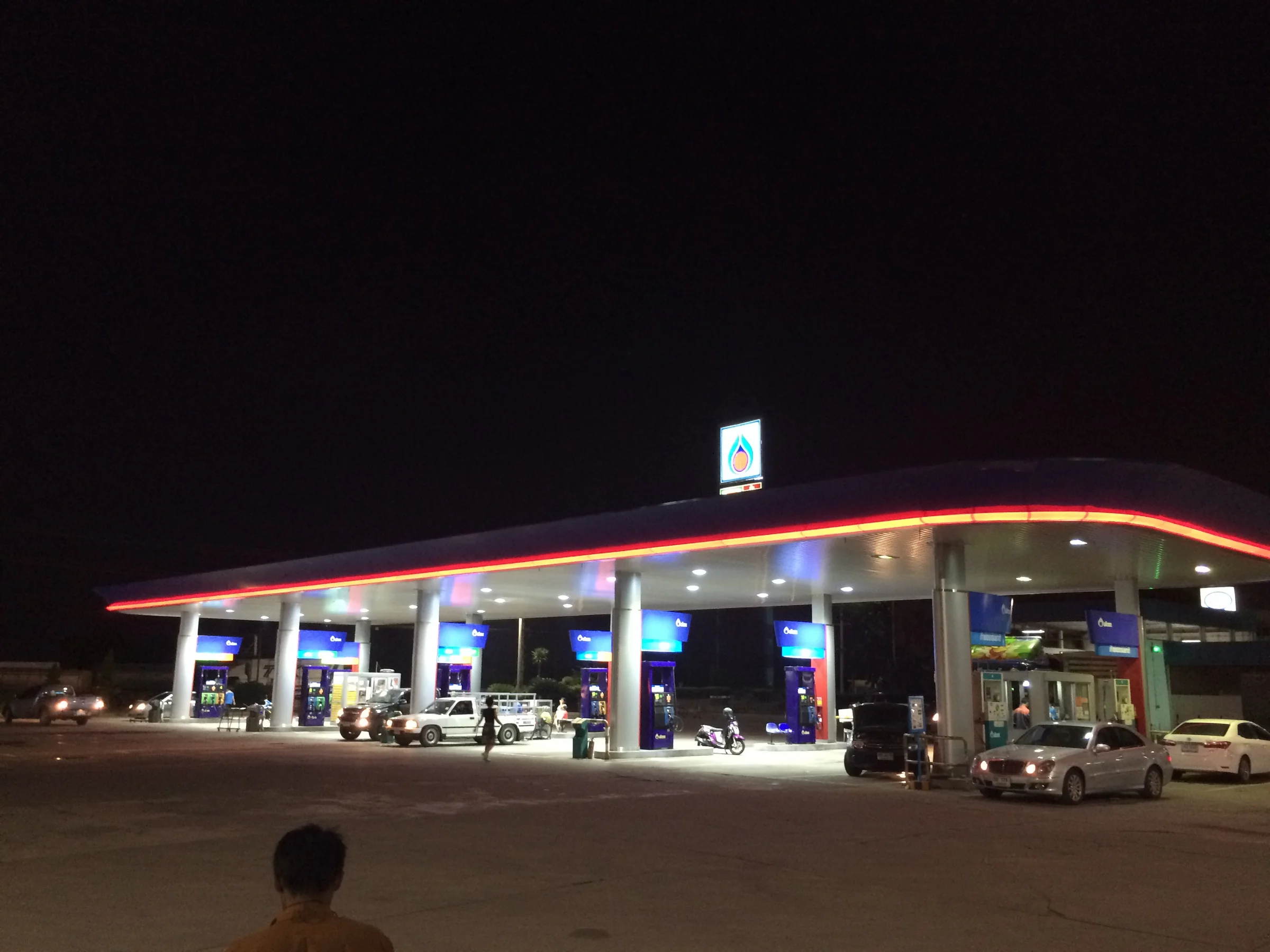
Illustrative image: a PTT filling station at night in Bang Kaeo, Samut Songkhram province, photographed in October 2014. It does not show current prices or a station in Phuket.
Photo: กิตติ เลขะกุล / Wikimedia Commons, CC BY 3.0 (https://creativecommons.org/licenses/by/3.0/).