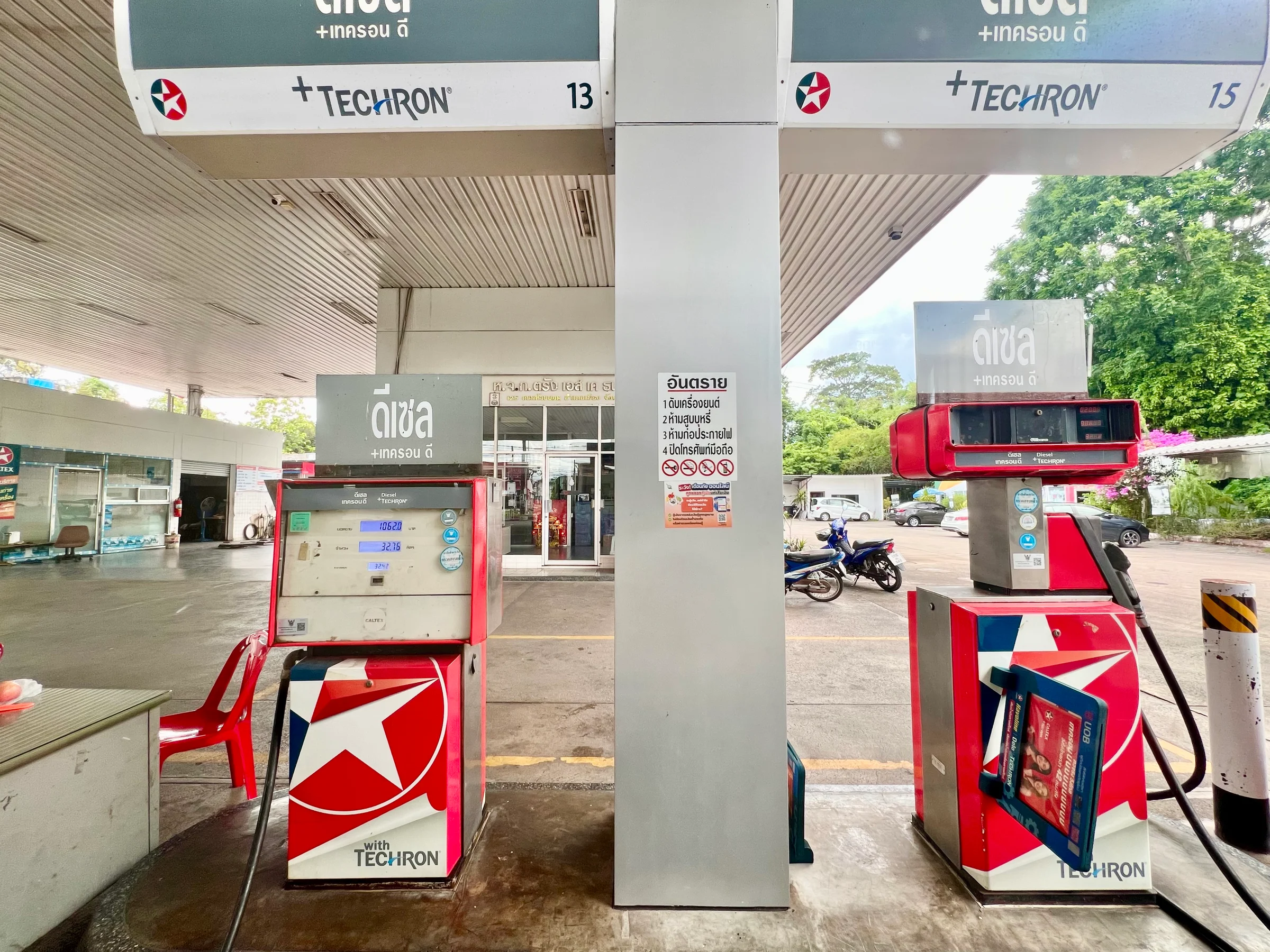
Filling up in Thailand got a little cheaper this week, and the reason is a change to a pricing rule most drivers have never heard of. On Wednesday 28 October 2026 Energy Minister Akanat Promphan signed an order changing how refinery-gate prices are calculated, with effect from 29 October. Refinery-gate prices are the wholesale prices Thai refineries charge before taxes, the Oil Fund levy and retail margins are added.
Since 2004 the formula has been pegged to Singapore market prices and then topped up with the cost of shipping that fuel to Thailand, plus insurance and allowances for losses in transit. The ministry's point is that fuel refined in Thailand is not actually shipped from Singapore, so those costs were never really paid. The new order takes them out.
How much prices fall
According to the Ministry of Energy, the change lowers refinery-gate prices by between 0.0875 and 0.3548 baht a litre, depending on the fuel. That adds up to about 29.7 million baht a day, or roughly 10.8 billion baht a year across the fuel system. B7 diesel, the standard diesel at Thai pumps, sees the biggest reduction at 0.3548 baht a litre, while Gasohol 95 falls by 0.3203 baht a litre.
On 29 October the Oil Fund committee, which manages the state fund used to smooth fuel prices, then cut retail prices. Thai PBS and The Nation reported that B7 diesel fell by 1 baht to 42.54 baht a litre, and Gasohol 95 and Gasohol 91 fell by 50 satang to 41.54 and 41.17 baht a litre.
What you will pay today
Pump prices published for Friday 30 October show no further change. At PTT and Bangchak stations in Bangkok and surrounding provinces, B7 diesel is 42.54 baht a litre, Gasohol 95 is 41.54 baht, Gasohol 91 is 41.17 baht, and both B20 diesel and E20 are 33.50 baht a litre. Premium grades cost more, and prices outside the Bangkok area can differ, so check the board at your local station.
Separately, the Oil Fuel Fund Office issued a new announcement on 29 October adjusting the per-litre amounts the fund collects and pays out on each fuel from 30 October. Those rates are reviewed often, so the pump price can move again at short notice even though the formula change itself is permanent.
Why it matters for residents
For most households the saving is modest but real. A driver using 50 litres of B7 diesel a month pays about 50 baht less than before 29 October. The bigger effect may be indirect: diesel is the main fuel for trucks, buses and many songthaews, so cheaper diesel can ease some of the pressure on delivery and transport costs.
This is a different measure from the temporary excise cut on E20 and B20 that Modern Expat Magazine reported earlier this week. That cut applies to those two blends only, while the formula change affects refinery prices across fuels.
If you run a car or motorbike on Gasohol 95 or 91, it is also worth checking whether your vehicle can take E20. At 33.50 baht a litre it is currently around 8 baht cheaper than Gasohol 95, but only use it if your owner's manual or dealer confirms it is compatible.